The Role Of Hplc Analysis In Peptide Characterization
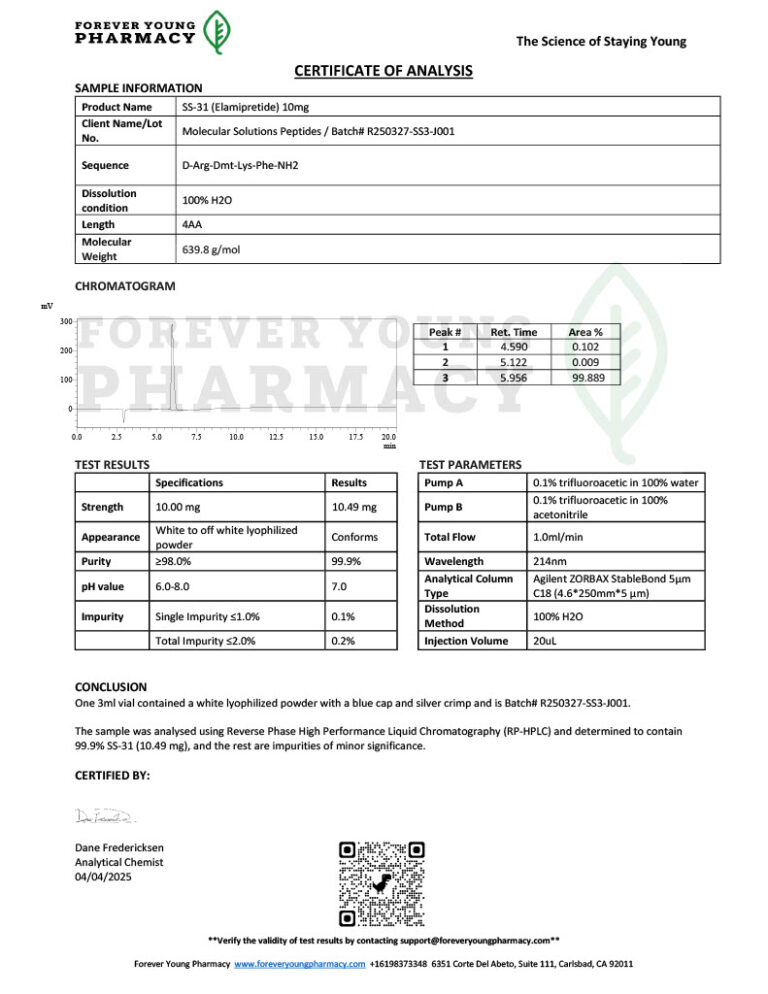
Just How To Test Peptides For Purity: Hplc, Ms & Coa Guide Use AAA, CE, or peptide mapping to reinforce the logical bundle when deeper verification is required. Several on-line peptide vendors do not supply Certificates of Analysis, and others offer COAs without independent confirmation. Only vendors making use of third-party lab screening give trusted quality documentation. All peptides marketed by Peptides Laboratory UK are purely for research laboratory study objectives just. They are not meant for human intake, medical usage, or cosmetic application. To confirm your COA see any one of our item web pages-- scroll down and replicate the set number, after that visit optimalabs.org to confirm. We will certainly select the most suitable elution solvent for you according to your sample features, sample kind and the solvent you use to liquify the sample. Initially, a small amount of the Pharmaceutical Research peptide is liquified in a liquid and injected right into the HPLC device. That fluid is after that pressed through a narrow tube (called a column) under high pressure. It is one reason appropriate peptide storage space and reconstitution techniques issue. In the typical peptide COA context, peak pureness usually refers to the portion of complete chromatogram area represented by the major peptide peak. It is an area-percent purity measurement, not a full identity or activity examination. Mass spectrometry confirms whether the measured mass matches the expected peptide mass. The top quality and dependability of a peptide pureness measurement depend on approach parameters and paperwork high quality. The mobile phase, commonly a combination of water, acetonitrile, and an acid modifier, is stored in storage tanks and delivered with the system by a high-pressure pump.
- For instances of product-level context, contrast the anticipated masses for Retatrutide, BPC-157, and Semaglutide.
- Every research study peptide provided by Peptides Lab UK is individually evaluated and third-party validated to verify peptide purity, molecular integrity, and credibility.
- Unfortunately, the on-line market for peptides is flooded with unproven sources and irregular purity levels.
- It is one reason correct peptide storage and reconstitution techniques matter.
- Mass spectrometry is an extensively utilized treatment observed as having exceptional sensitivity.
Targeting Cookies
Lyophilised peptides must be stored at -20 ° C or colder, safeguarded from moisture and light. When reconstituted in remedy, peptides are much more susceptible to degradation through oxidation, deamidation, and temperature level variations. Aliquoting reconstituted peptides right into single-use sections protects against duplicated freeze-thaw cycles. Recognizing how to examine peptides for purity makes certain the reliability and reproducibility of every study protocol. This guide describes the three gold-standard analytical methods-- HPLC, Peptide Vials mass spectrometry, and third-party screening-- and how scientists can translate outcomes to verify that their compounds meet research-grade quality criteria. Without orthogonal approaches to discover these microheterogeneities, they increase in a system (passing away as 'biological variability'), lowering signal-to-noise and ultimately invalidating entire information sets. Formal HPLC/MS characterization ices up that entropy in place, subjecting each particle to two orthogonal option stress (hydrophobicity and mass-to-charge), creating an analytical firewall around false identity. Normal pureness levels vary between 99.0% and 99.7%, aligning with international research laboratory research study standards. These examinations verify that peptides from Peptides Lab UK have no pollutants, destruction by-products, or undesirable fillers-- simply confirmed, high-purity research material.Peptide Research Study Reference: Reconstitution, Purity, Receptor, And Storage Space Terminology
Just how much time does an HPLC examination take?
Time Required for HPLC EDTA Examination Reports + Following Steps